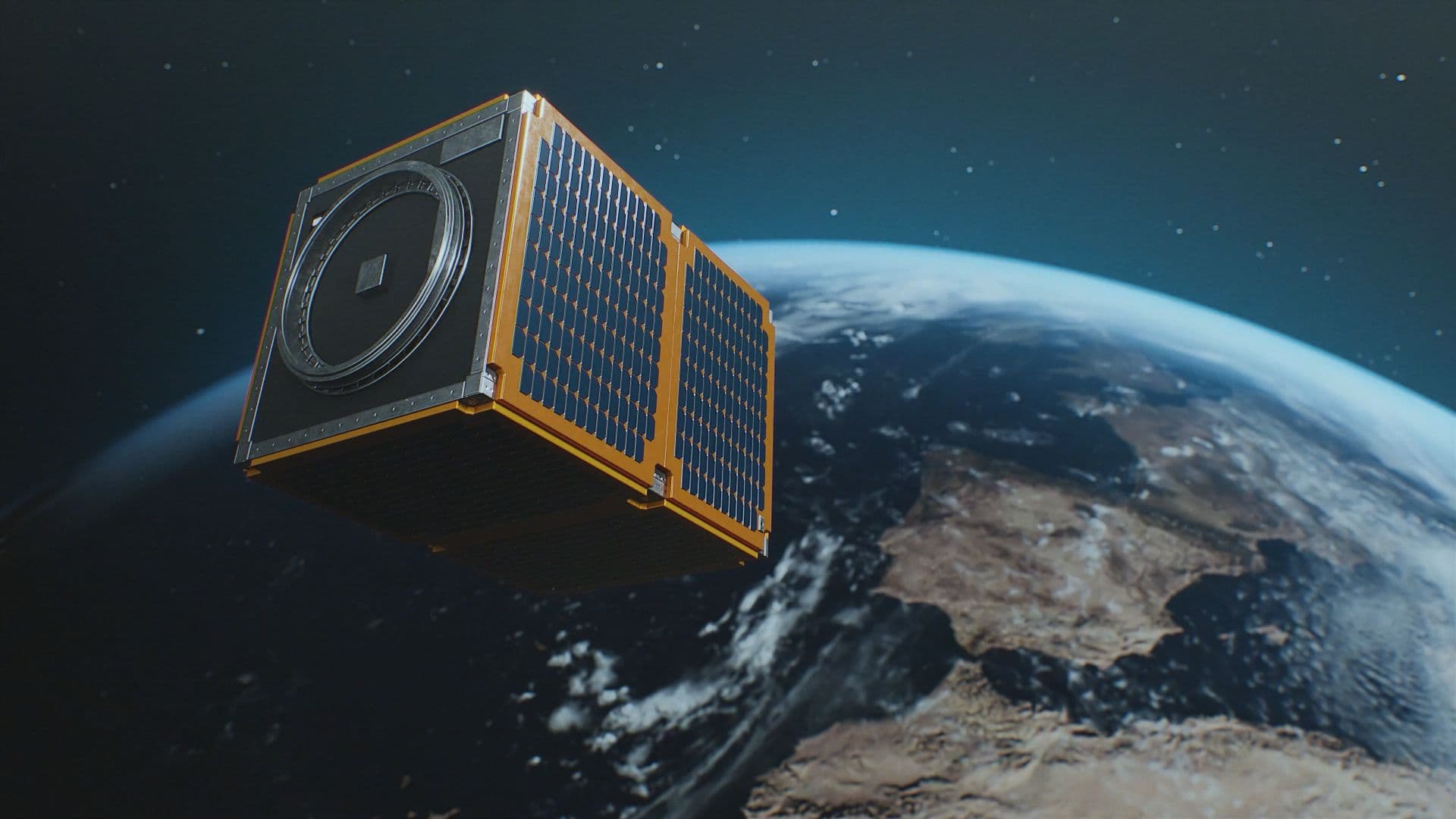
Tracking Sensor: monitoring ‘space debris’ for a safer future
The Tracking Sensor focuses on monitoring space debris in LEO and MEO orbits
3 reading time

What is the Tracking Sensor? According to recent data from the European Space Agency (ESA), around 54,000 objects larger than 10 cm currently orbit the Earth, and it is estimated that there are nearly 1.2 million fragments between 1 cm and 10 cm. The vast majority are inactive objects moving uncontrollably, posing a real risk of collision with operational satellites.
A single collision can generate new fragments and trigger a cascading multiplier effect. Combined with the annual increase in launches and satellites in orbit, the space debris problem has become a major challenge.
To strengthen Europe’s Space Surveillance and Tracking (SST) capabilities—aimed at achieving independence and improving data quality—Indra has developed the Tracking Sensor (S3TTR), a cutting-edge sensor for the European SST network.
This project covers the development, deployment, validation, and operational launch of the Tracking Sensor, focusing on debris tracking in LEO and MEO orbits. It is a valuable asset for expanding and enhancing Europe’s SST capabilities.
Key features of Indra’s Tracking Sensor
Indra’s Tracking Sensor is an advanced system designed for high-precision space tracking. It excels in detecting, following, and characterising objects in LEO and MEO, including centimetre-sized debris, ensuring comprehensive monitoring of the orbital environment. It also incorporates the potential to generate high-resolution images, enabling detailed object characterisation and providing valuable information on shape, size, and other attributes.
The sensor is designed for future integration into European defence systems, allowing ballistic missile tracking and ensuring interoperability through standard NATO interfaces.
Core functionalities of the Tracking Sensor
- Conjunction prediction: anticipating potential collisions between orbiting objects.
- Re-entry prediction: accurately calculating the timing and trajectory of objects returning to Earth’s atmosphere.
- Fragmentation detection: identifying and tracking debris from fragmentation events.
- Orbit determination and maintenance: improving orbital data accuracy and keeping space object catalogues up to date.
- Detailed object characterisation: providing precise information on shape, size, and composition.
Tracking Sensor: technical highlights
The sensor features advanced engineering for exceptional performance in space surveillance. Its antenna—a large Cassegrain reflector with a 13.2-metre diameter—works with a high-speed positioner offering full movement, enabling wide tracking coverage from 0° to 360° in azimuth and 10° to 90° in elevation.
Its range ensures detection of objects in LEO and MEO, with precision adapted to the installed RF power. Designed for 99% availability over a year, it guarantees continuous and reliable operation.
The technology includes innovations such as digital beamforming for synthetic monopulse radiation patterns, direct digital RF generation, and RF sampling based on RFSoC devices—placing this sensor at the forefront of space technology. Imaging capability further enhances object characterisation, significantly increasing the value and applications of the data obtained.
Why is the Tracking Sensor important?
This system represents a major step forward in space surveillance, substantially improving observation and characterisation of space objects. By complementing existing surveillance sensors in catalogue maintenance, it contributes effectively to the European and global SST network.
Its precision in predicting collisions and re-entries greatly reduces associated risks. It also enables more effective tracking of fragmentation events, facilitating identification and monitoring of space debris.
Finally, its imaging capability broadens applications in both civil and defence domains, delivering detailed, valuable information for a wide range of users.
Indra’s Tracking Sensor is an advanced system designed for high-precision space surveillance. It stands out for its ability to detect, track, and characterise objects in Low Earth Orbit (LEO) and Medium Earth Orbit (MEO), including those as small as a few centimetres, ensuring detailed monitoring of the space environment.